
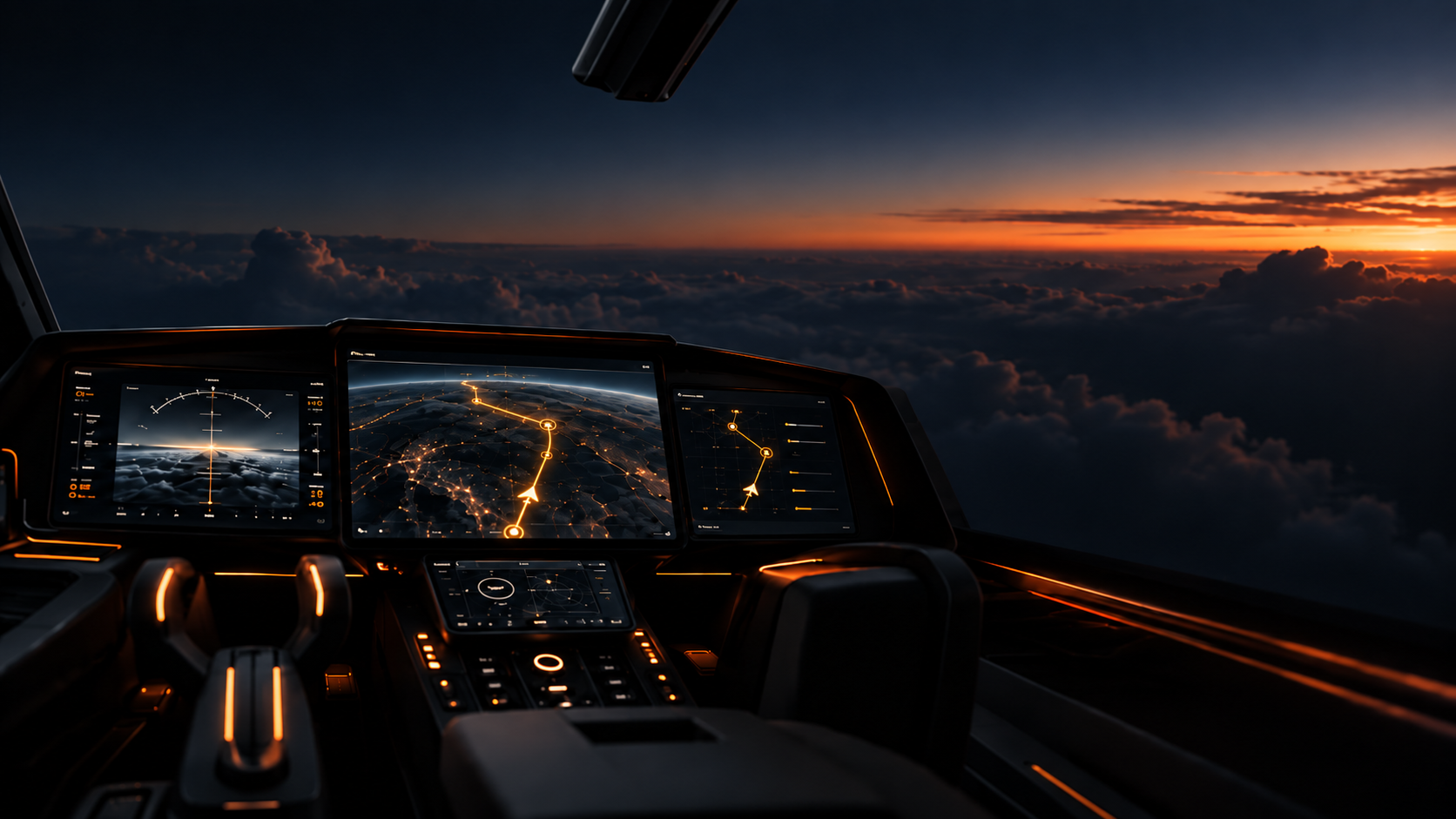
Flight autonomy
The Pilot
You choose where.
The Pilot handles how.
Ascerex is developing an autonomous flight system intended to operate the Orbiter from departure to arrival without making routine travel depend on passengers manually flying the aircraft.
One autonomous Pilot across the complete flight
- 01Takeoff
Establish controlled vertical flight.
- 02Transition
Manage changing lift and control demand.
- 03Route
Follow the eligible Skyway path.
- 04Approach
Exit the route and prepare to land.
- 05Landing
Complete or safely terminate the mission.
Why autonomy is essential
Complete flight should not become passenger workload.
Manually flying an aircraft requires continuous attention to vehicle state, control demand, energy, navigation, and changing conditions. The Pilot is intended to take responsibility for that workload throughout the journey.
That makes autonomy more than a convenience feature. It is the integration layer that turns an aircraft and an operating network into transportation designed for routine travelers.
- Passenger
- Choose the destination without carrying the continuous workload of manual aircraft control.
- Pilot
- Control and supervise takeoff, transition, route flight, approach, and landing as one continuous operation.
- Operating boundaries
- Act only within the Orbiter's physical limits, Skyway authority, and the aircraft state the system can justify.
Continuous control
The Pilot never stops checking.
- 01Sense
- 02Understand
- 03Plan
- 04Control
- 05Monitor
- 01Sense
Collect aircraft and environmental state.
- State estimationUnderstand
Estimate where the aircraft is and what condition it is in.
- 03Plan
Determine the next valid action inside Vehicle and Skyway boundaries.
- 04Control
Translate that action into bounded flight-control and propulsion commands.
- 05Monitor
Compare expected and actual behavior, then feed the result back into the loop.
The Pilot continuously compares expected and observed aircraft behavior
- 01Nominal
Observed behavior follows the expected aircraft response.
- 02Deviation detected
Measured behavior no longer matches what the Pilot expected.
- 03Detect
The mismatch is recognized through continuous aircraft-state monitoring.
- 04Contain
Control commands remain bounded while the response is stabilized.
- 05Reassess
The Pilot determines what authority and mission options remain.
- 06Safe action
The next action must be supported by the aircraft state and operating boundaries.
Safety isn't a reaction at the end.
It's a loop running throughout the flight.
The Pilot is being developed to reduce exposure to avoidable human error through continuous aircraft-state supervision and bounded automated response.
04 / Development and verification progression
Authority follows evidence.
Increasingly consequential control authority requires increasingly strong verification evidence.
- 01Simulation
Bounded scenarios and explicit assumptions.
- 02Software-in-the-loop
Control logic evaluated against simulated systems.
- 03Hardware-in-the-loop
Computing, sensors, and interfaces introduced.
- 04Integrated vehicle testing
Subsystem behavior evaluated together.
- 05Flight testing
Physical evidence within controlled envelopes.
- 06Operating evidence
Evidence appropriate to approval and certification work.
05 / The passenger experience
The destination belongs to the traveler.
The workload belongs to the system.
Routine Orbiter travel is intended to require a destination—not the continuous workload of manually flying an aircraft. The Vehicle defines what is physically possible, the Skyway defines where travel is eligible, and the Pilot turns both into autonomous movement.
- Passenger input
- Choose the destination.
- Pilot responsibility
- Control and supervise the complete flight.